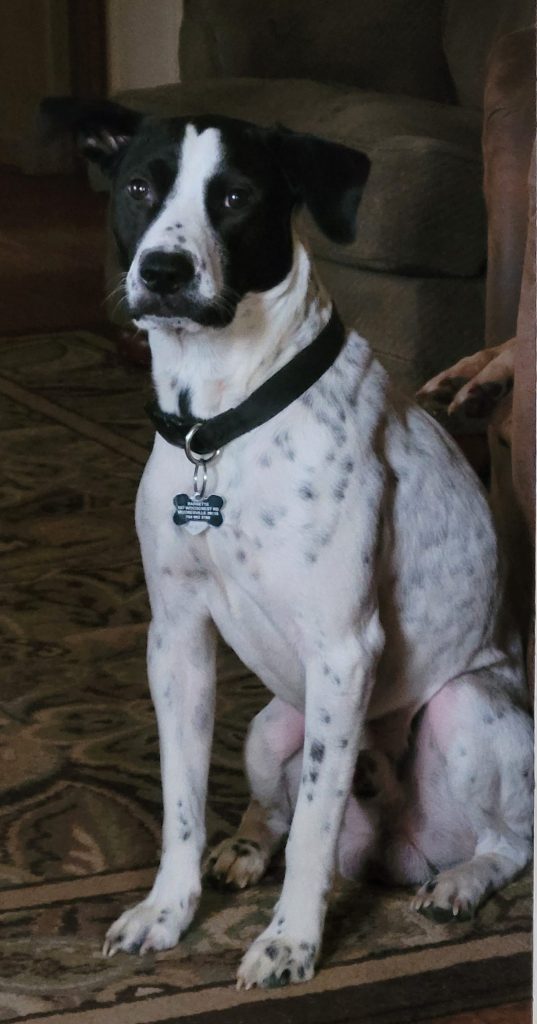
Meet Henry. He is a Blue Heeler, also known as an Australian Cattle Dog. We have known each other for several years and have become quite close in that time. We are so close, in fact, that there are several things that I know about Henry.
I know that Henry is not my dog. My brother brought Henry into our parent’s home several years ago as a pet for my niece. While Henry belongs to my brother and my niece is ‘His Girl,’ I have the privilege of being his food-bowl-filler and door-opener and car-ride-and-hang-out-all-day-buddy. It has been the two of us alone facing the quiet mornings and growing closer in our grief.
I know that Henry thinks he is a nurse or caregiver. He is constantly at my side, helping me help my husband the same way he would help me help my mother. People we come across in our adventures who happen to be riding in or pushing a wheelchair are a-okay in Henry’s opinion. People without a wheelchair are suspicious and Henry becomes a very protective dog. And though Henry is not a trained service animal, he has a proven track record of alerting us to potential issues that would have become much larger problems.
I know that Henry is one of the most gentle and loving dogs I have had the privilege to know. He reaches out his paw to softly lay it in my hand, leans into a hug as he tucks his head under my chin, and rests his head on my knee so lightly that I don’t notice it until I feel his puppy-eyed stare begging for my attention. He is so attuned to the people who live in this house that he often knows our moods before we do.
I know that Henry was worried about my husband with me today. We wait for my husband on the bench in front of the clinic on dialysis days, enjoying the weather and watching the world go by. Henry usually lets me know when my husband is on his way out before the automatic doors begin to open. We have a routine. Today’s routine was interrupted by the existence of an ambulance near the clinic’s bay door – lights on, but no siren.
I know Henry watched the activity about 50 feet away as I sat on the bench and held onto one thought like it was my mantra, my affirmation, my manifestation — If it’s my guy in that ambulance, the clinic would have called me. I watched Henry shiver as he watched the ambulance leave quietly and slowly and we were surprised as it was followed out by a second quiet, slow ambulance. Henry continued to shiver as he watched me watching him and waiting for my phone to ring. But my phone did not ring.
I know Henry turned to the door moments before it opened. I wasted no time getting Henry and my guy into the car and stowing the wheelchair in the trunk. I joined them after wiping away my tears of relief only to find Henry trying to cuddle my husband in the front seat. He was trying to tuck himself under my husband’s arm while also curling around my guy’s ribcage despite the safety belt and seat design.
I know Henry knew. He knew that I was worried. What I learned was that he had not just known and understood my worry, he had shared it.
I know that Henry is not my dog. He does not belong to me or my husband. But I also know that we – my husband, my daughter, my brother and my niece – belong to Henry. We are his herd, his responsibility. And he is, I know, a very good boy.
- Quick Facts About AUSTRALIAN CATTLE DOGS
- (a.k.a. Queensland Heeler, American Cattle Dog)
- Bred to “drove” cattle over long distances and rough terrain by biting and nipping at the cattle
- Medium sized dog with a short, double coat
- As a ‘working breed,’ they are usually energetic, intelligent and often independent
- Few differences between the Australian (more working dog) and American (more companion dog)
- Two main colors over a white coat in a mottled or speckled pattern
- Blue Heeler – black hair
- Red Heeler – red hair


Leave a Reply